Largest volume postcard printer in the world; the Curt Teich Archives (Newberry Library) hold ~2.5 million items
Production numbers encode dates; see decoder
Signature processes: C.T. Art Colortone (linen), Curteichcolor (chrome)
Family sold the company in 1974; Regensteiner Publishing produced Teich-branded cards until the Chicago plant closed in 1978
The printer’s own mark: the Curt Teich & Co. monogram, Chicago. This is what tells you a card came out of the Teich plant, whoever’s name is on the front.Scanned from the Postcard Origins collectionAnd the process line beside it, C. T. AMERICAN ART COLORED. Careful here — Teich reused the “American Art” name on a later four-colour series, so the brand alone will not date a card. The production number does.From the collection
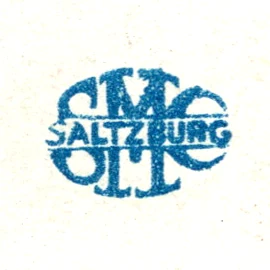
Three names, three jobs. Teich printed this card — but Saltzburg’s Merchandise Co. of Atlantic City published it, and their mark sits on the same back.Scanned from the Postcard Origins collectionPUBLISHED BY SALTZBURG’S MERCHANDISE CO., ATLANTIC CITY, N. J. A publisher’s active years can bound a date, but when a printer’s production number is present, the number wins.From the collection
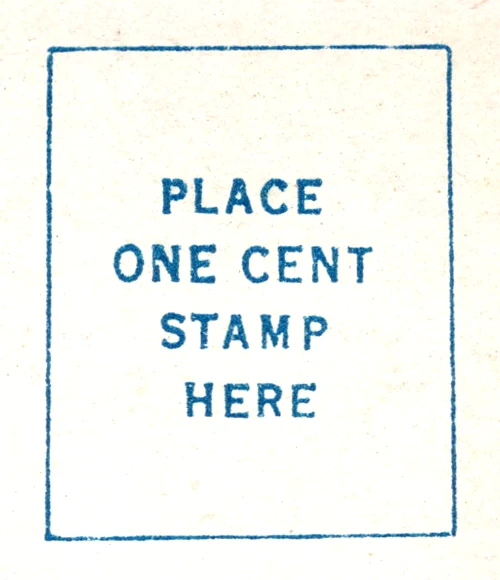
The stamp box on the same card, printed PLACE ONE CENT STAMP HERE. A denomination printed into the box records the postcard rate the publisher expected when the card went to press — a clue in its own right. Check it against the rate table: this card’s production number decodes to 1926, comfortably inside a one-cent era.Scanned from the Postcard Origins collection
Dating this publisher’s cards
US. The production number encodes the year of first printing, often to the exact year; enter it in the decoder. A ’-N’ suffix marks a reprint.